
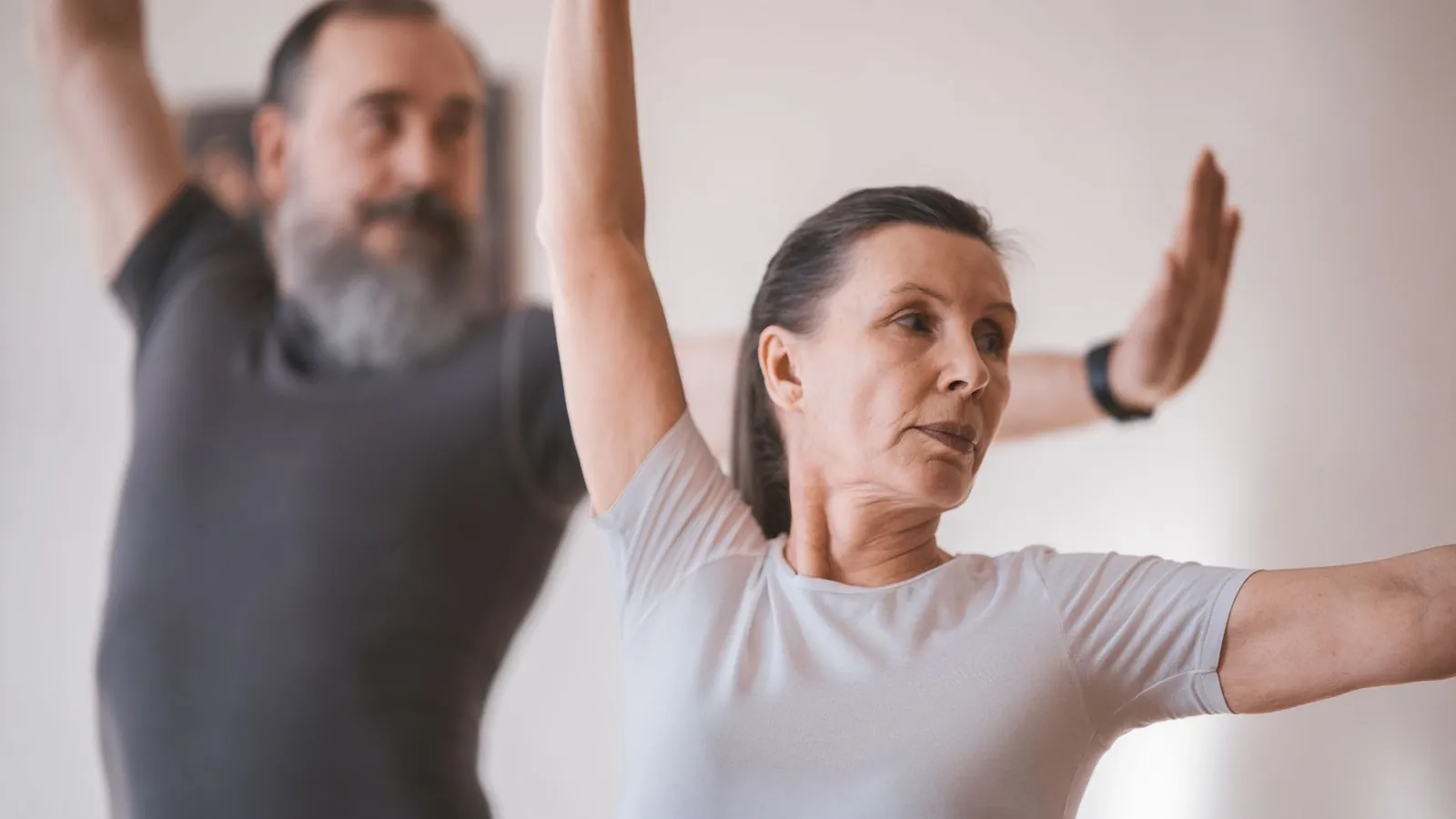
Roughly one in three adults over 65 falls each year, and about half of those over 80. Most falls cause no injury. The ones that do can change everything: a hip fracture, a loss of confidence, and a retreat from activity that accelerates the very decline that caused the fall.
The important and underappreciated point is that this is largely preventable. Balance is a trainable capacity, and it responds to training at 85 much as it does at 45.
Why balance declines
Staying upright depends on three sources of information and one system to act on them:
- Vision, which is why balance is markedly worse in the dark
- The vestibular system in the inner ear, sensing head position and movement
- Proprioception, the sense of where your joints are, particularly from the feet and ankles
- Muscle strength and speed, which is what actually corrects you once a wobble begins
Each of these declines gradually with age. Add reduced ankle mobility, slower reaction time, several medications, and the loss of fast twitch muscle fibres, and the margin for recovering from a stumble narrows.
The critical variable is not whether you wobble. Everyone wobbles. It is whether you can generate a fast enough, strong enough correction before the wobble becomes a fall. That correction is muscular, and muscle is trainable.
Walking is not balance training
This is the most common misunderstanding, and an expensive one.
Walking is excellent for cardiovascular health, mood, bone density and general function. Please keep walking. But walking on level ground practises a movement you are already competent at, in a stable environment, and it does not challenge balance enough to improve it.
Balance improves when it is challenged, in the same way that strength improves when muscles are loaded. That means practising in positions that feel slightly unsteady, safely, and regularly.
The evidence here is quite specific. Programmes that reduce falls share three features: they challenge balance meaningfully, they include strength work, and they are done for at least three hours a week over several months. Programmes that miss those features generally do not reduce falls.
What challenging balance safely looks like
Always beside a kitchen counter or a solid chair back, close enough to reach in an instant. Progress only when a stage is easy for the full time.
| Stage | Exercise | Target |
|---|---|---|
| 1 | Feet together, eyes open | 30 seconds |
| 2 | Feet in a narrow line, one partly in front | 30 seconds each side |
| 3 | Heel to toe, one foot directly in front of the other | 30 seconds each side |
| 4 | Standing on one leg | 30 seconds each side |
| 5 | Any of the above with head turns left and right | 30 seconds |
| 6 | Any of the above on a cushion or folded towel | 30 seconds |
Fingertips on the counter to begin. Then one finger. Then hovering. Then hands off with the counter still within reach. That progression is the training.
Add head turns as early as you safely can, because most real falls happen while doing something else: turning to talk, reaching for a shelf, looking for the doorbell.
Strength is half the answer
Balance reactions are muscular. If the muscle cannot produce force quickly, the correction does not arrive in time.
The priorities:
- Sit to stand from a chair. The single most valuable exercise on this page. Hands off if possible, ten repetitions, several times a day
- Calf raises. The ankle is the first joint to respond to a small sway, and it needs to be strong and fast
- Step ups. Onto a low step, controlled on the way down as well as up
- Getting up from the floor. Practise it with someone present. Knowing you can get up changes how you move through the world
Being unable to rise from a chair without pushing off with the arms is a well recognised warning sign, and it is one of the most reversible.
The strength and balance work above is packaged as a daily routine in our balance and falls prevention set, with the dose for each exercise and the staged progression to follow.
The things people forget
Medication review. Four or more medications, or anything sedating, significantly raises fall risk. Ask a pharmacist or doctor for a review. This is one of the highest value actions available and it costs nothing.
Eyes. Annual checks. Be careful with varifocals on stairs, where they blur exactly the part of the visual field you need. Many people benefit from single vision lenses for walking outdoors.
Feet and footwear. Pain, numbness and poor footwear all reduce the ankle information you depend on. Firm, fitted, low heeled shoes with a good grip. Not slippers, and not barefoot on smooth floors.
Vitamin D and bone health. Does not prevent falls by itself, but changes what happens when one occurs.
The home. Loose rugs, trailing cables, poor lighting on the route to the bathroom, no rail on the stairs, a bath with no mat. Most of this is cheap to fix.
Fear itself. Fear of falling causes people to move cautiously and do less, which reduces strength and balance, which raises the actual risk. It is a self fulfilling loop, and confidence built through demonstrated capability is the way out of it.
Get assessed if
You have fallen in the last year, you have had a near miss, you have started holding onto furniture around the house, you cannot stand from a chair without using your arms, you feel unsteady turning around, or you have begun avoiding going out because of how you feel on your feet.
A fall is not an inevitable part of getting older, and one fall is not the beginning of an irreversible decline. It is a signal that the margin has narrowed, and the margin can be widened again.