
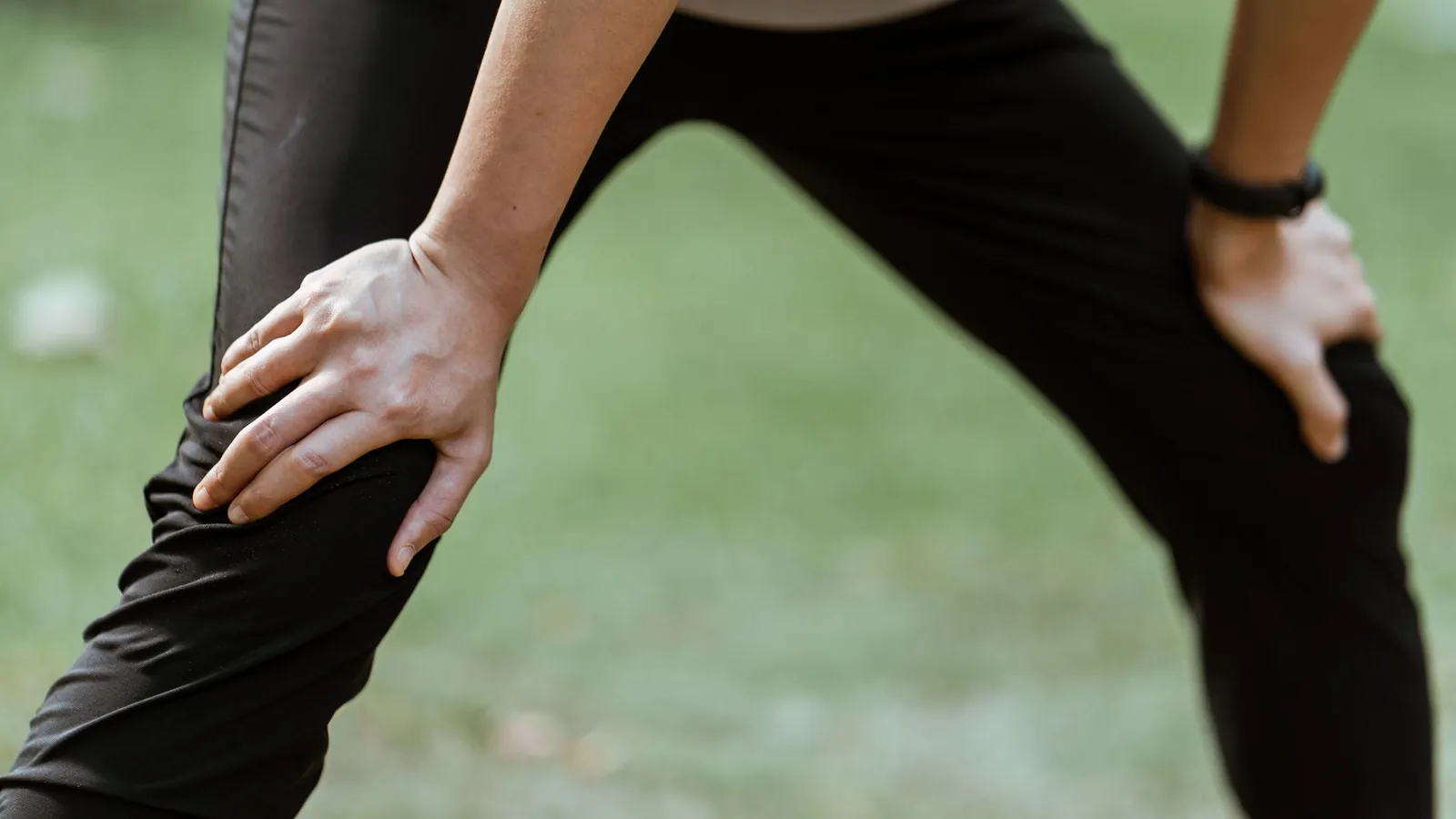
Stairs are one of the most demanding things we ask a knee to do in ordinary life. Going down, the joint absorbs several times body weight while the quadriceps lengthen under load. So stairs tend to reveal knee problems long before flat walking does.
Which direction hurts is genuinely diagnostic, and it is worth paying attention to.
Down hurts more: usually the kneecap
Pain descending stairs, felt around or behind the kneecap, most often points to patellofemoral pain: irritation of the joint between the kneecap and the thigh bone.
Typical picture:
- A diffuse ache around the front of the knee, hard to point to with one finger
- Worse going downstairs, downhill, or after long periods sitting with the knee bent
- Sometimes grinding or clicking, which on its own is not a concern
- Common in active adults, and more common in women
It is usually a load-distribution problem rather than damage: the kneecap tracks through its groove under high compression, and weakness at the hip and thigh changes how that load is shared.
Up hurts more: often the tendon or the joint
Pain climbing stairs more than descending shifts suspicion towards:
- Patellar tendinopathy: pain localised to a specific tender spot just below the kneecap, common in people who jump or squat regularly
- Early osteoarthritis: stiffness after rest, some morning creakiness that eases within 30 minutes, more common past middle age
- Quadriceps weakness: straightforward strength deficit, often after a period of inactivity or injury
What about the meniscus?
Meniscal irritation usually produces pain on twisting and pivoting rather than straight stair work, often with a sense of catching or the knee giving way. Like disc bulges in the spine, degenerate meniscal changes are extremely common on scans in people with no symptoms at all, so an incidental finding does not automatically explain your pain.
Arthroscopic surgery for degenerative meniscal tears has repeatedly failed to outperform structured exercise therapy in trials. Rehabilitation is the first-line treatment for the large majority.
The exercises that make the difference
Nearly all of these problems respond to the same principle: build capacity in the muscles that control the knee, starting below the level that provokes pain.
Quadriceps strength is the highest-value target. Start with static holds and short-arc work if the knee is irritable, then progress to loaded squats and step-downs as tolerance improves.
Hip strength matters more than most people expect. Weak glute medius allows the thigh to collapse inward when you load a single leg, which increases stress across the kneecap. Side-lying leg raises, banded walks and single-leg work all address this.
Calf strength contributes to shock absorption on descent and is routinely neglected.
A reasonable weekly structure is strength work every other day, progressive in load, with walking maintained in between.
Managing it day to day
- Descend stairs one at a time initially if it is very sore, leading with the less painful leg
- Avoid prolonged sitting with the knee fully bent, and shift position regularly
- Keep walking; total rest weakens the exact muscles you need
- Expect improvement over six to twelve weeks of consistent loading, not days
| Symptom | More likely |
|---|---|
| Worse going down | Patellofemoral pain |
| Worse going up | Tendinopathy or early arthritis |
| Twisting, catching, giving way | Meniscus |
| Swelling after activity | Joint irritation, get assessed |
When to get it looked at
Book an assessment if the knee swells repeatedly, locks or gives way, if you cannot fully straighten it, if pain followed a specific twisting injury, or if it is simply not improving after six weeks of sensible self-management.
Persistent knee pain rarely resolves by waiting, and the muscles that protect the joint weaken in the meantime, which makes the problem progressively harder to reverse.