
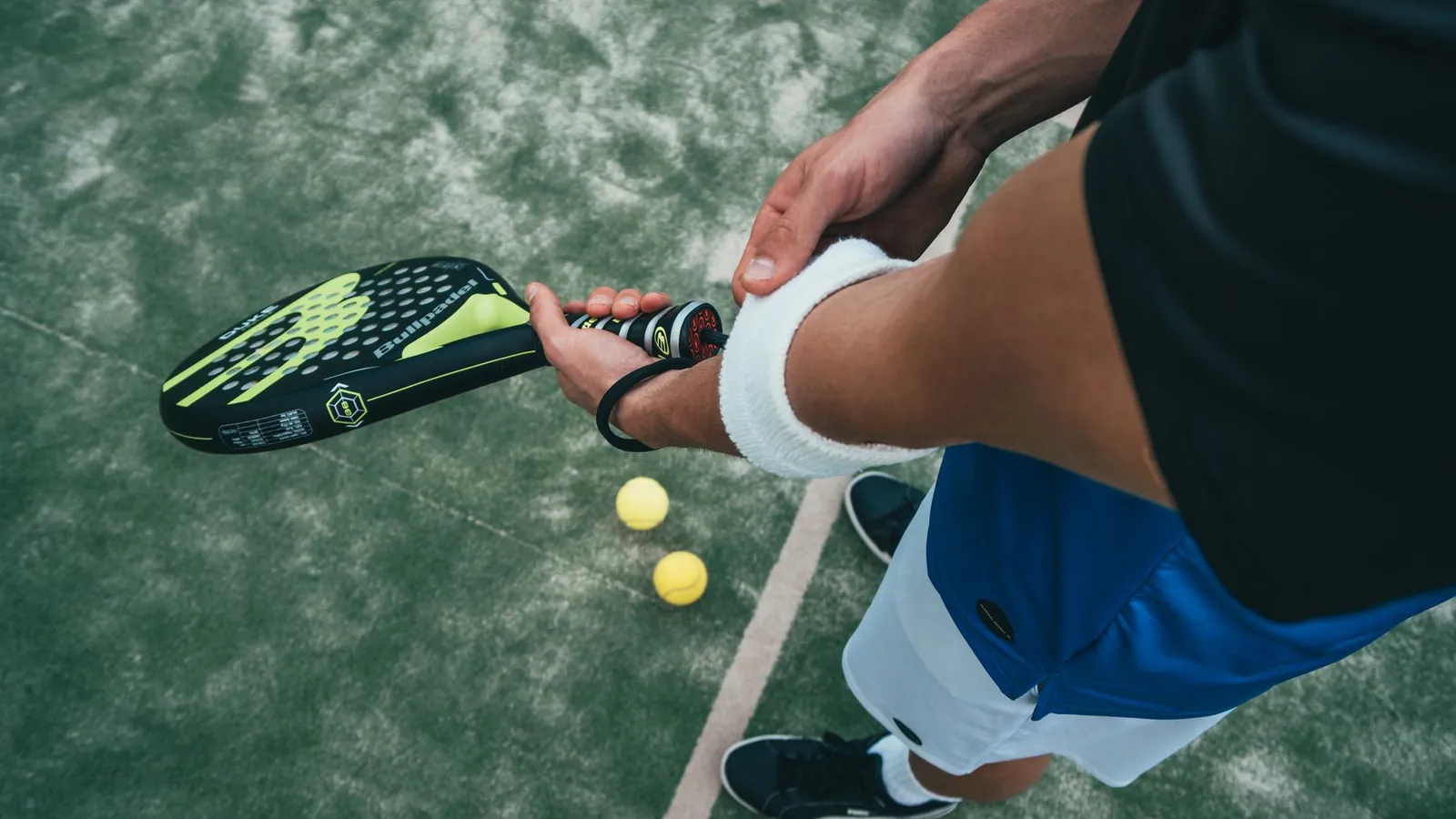
You reach for a full kettle and a sharp pain bites on the outside of your elbow. Shaking hands hurts. Turning a doorknob hurts. Lifting a mug from above rather than from the side is somehow fine.
That pattern is tennis elbow, and roughly nine in ten people who have it have never held a racquet.
What is actually going on
The muscles that lift your wrist and straighten your fingers all converge into one tendon that attaches to a small bony bump on the outside of the elbow, the lateral epicondyle. Every time you grip something, those muscles contract to stabilise the wrist, whether or not your wrist is moving.
That means gripping loads the elbow tendon. Every single time.
The medical name is lateral epicondylitis, and the "itis" is misleading. When these tendons are examined under a microscope there is very little inflammation. What there is instead is disorganised collagen: the tendon fibres have lost their neat parallel alignment and the tissue has become disorganised and less able to tolerate load.
This distinction matters practically, not academically. An inflammation problem is treated by calming things down. A tissue capacity problem is treated by rebuilding capacity, which is close to the opposite.
Does this sound like yours?
- Pain over the bony point on the outside of the elbow, sometimes spreading into the forearm
- Worst with gripping, especially with the arm straight
- Kettles, jars, doorknobs, shopping bags and handshakes are the usual culprits
- Sore to press directly on the bony point
- Morning stiffness in the forearm that eases after a few minutes
- Grip strength noticeably reduced, sometimes dropping things
Two quick self tests. Straighten your elbow, make a fist, and lift your wrist against resistance from your other hand. Then straighten your elbow and lift just your middle finger against resistance. If either reproduces the pain at the bony point, that points strongly at the extensor tendon.
Why it started
Tendons fail when load outruns capacity. Something changed on one side of that equation:
| What changed | Typical example |
|---|---|
| A sudden increase in load | A weekend of DIY, painting a room, moving house |
| A new repetitive task | Starting a job with heavy manual handling |
| A change in technique or equipment | New racquet grip size, different tools, new keyboard and mouse |
| Reduced capacity | A period of inactivity, then returning to normal load at full speed |
| Neck involvement | Nerve irritation from the neck lowering the tendon's tolerance |
That last row is the one most often missed. Irritation of the nerve roots in the neck can make the forearm tendons more sensitive and slower to recover. If your elbow pain comes with neck stiffness, or with any tingling in the hand, the neck deserves examining too. Our guide to neck pain from desk work covers what that looks like.
Why rest alone does not work
Rest reduces pain, and it does so reliably. It just does not restore the tendon.
If you rest for six weeks the pain will usually settle, because you have removed the load. Capacity, meanwhile, has fallen further. The moment you pick up the kettle again you are loading a weaker tendon than the one that failed in the first place, which is why tennis elbow so commonly returns within a few months of "resting it".
Tendons adapt to load. Removing load removes the stimulus to adapt.
What genuinely helps
Modify, do not stop. Reduce the aggravating loads rather than eliminating all activity. Carry with the palm facing up, lift with two hands, use a jar opener, get a wider handle where you can. You are lowering the daily load so the tendon has room to build.
Load it deliberately. This is the treatment. Isometric holds are the usual starting point: hold the wrist in a lifted position against light resistance for 30 to 45 seconds, five repetitions, once or twice a day. They frequently reduce pain for a couple of hours afterwards, which makes them a good entry point.
Progress to slow, heavy work. Once isometrics are comfortable, move to slow wrist extensions with a light dumbbell or a resistance band, three seconds up and three seconds down. Discomfort of two or three out of ten during the exercise is acceptable and expected. Pain that is worse the following morning means the dose was too high.
Grip strength work. Since gripping is what provokes it, gripping is what has to be rebuilt, gradually.
Expect this to take months, not weeks. Tendons remodel slowly. Six to twelve weeks of consistent loading is a realistic timeline, and it is worth knowing that at the start rather than concluding at week three that it is not working.
What about braces, injections and shockwave
Counterforce braces (the strap worn just below the elbow) reduce pain for many people during activity. Useful as a symptom aid while you load. Not a treatment on its own.
Corticosteroid injections produce good short term relief and worse outcomes at one year than doing nothing at all. That finding is consistent across several trials. Injections are worth discussing only in specific circumstances, and never as a first step.
Shockwave therapy has mixed evidence, and where it helps it works alongside a loading programme rather than replacing it.
What else causes pain in the same place
Not everything on the outside of an elbow is a tendon:
- Radial tunnel syndrome, where the pain sits slightly further down the forearm and feels more like an ache than a sharp bite
- Referred pain from the neck, which usually comes with neck symptoms or tingling
- Elbow joint problems, which typically limit how far the elbow straightens or bends
- Golfer's elbow, the same problem on the inside of the elbow, provoked by gripping with the wrist bending down
Get it assessed if
The elbow locks or gives way, you have numbness or weakness in the hand, the pain followed a fall, there is swelling over the joint itself, or you have been loading it consistently for three months with no change.
Most tennis elbow responds well once the loading is right and the dose is honest. The two things that derail it are stopping too early because it has become comfortable, and pushing too hard because progress felt slow.