
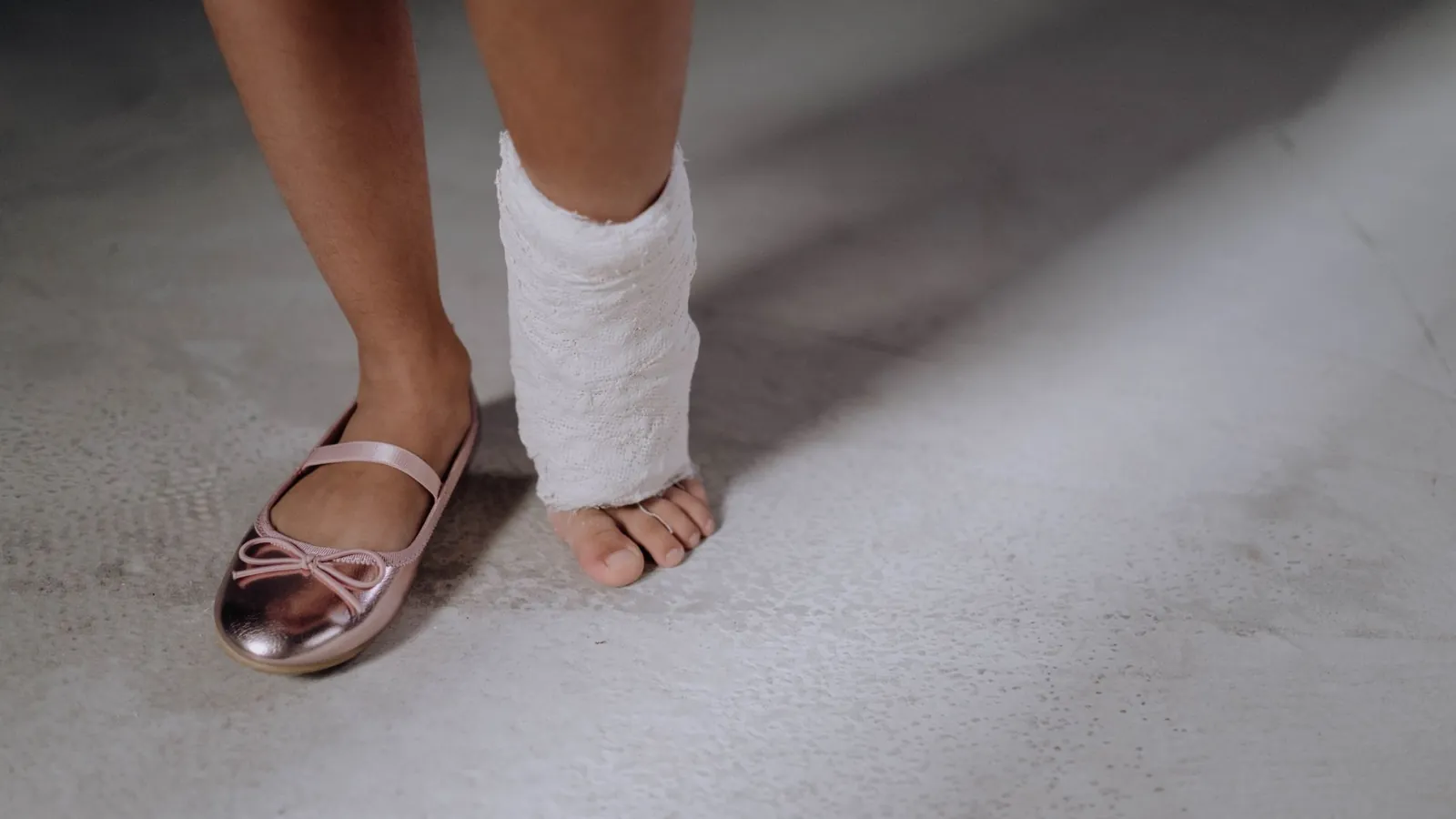
Ankle sprains are the most common injury in sport and one of the most commonly undertreated. The reason matters: roughly a third of people who sprain an ankle go on to develop chronic ankle instability: recurrent giving way, repeated sprains, lingering weakness. Almost all of that is preventable with a few weeks of the right rehabilitation.
Do you need an X-ray?
Most sprains do not. Clinicians use a well-validated set of criteria to decide, and you can apply the essentials yourself. An X-ray is warranted if:
- You cannot bear weight for four steps, both immediately and at assessment
- There is bone tenderness along the back edge or tip of either ankle bone
- There is bone tenderness over the navicular or the base of the fifth metatarsal (the bony bump on the outer midfoot)
If none of those apply, a fracture is very unlikely.
The first 72 hours
The old RICE advice has been revised. The current framing, PEACE & LOVE: reflects two changes in thinking: avoid anti-inflammatories early, and start loading sooner.
| Do | Why |
|---|---|
| Protect for 1–3 days | Limit movements that reproduce sharp pain |
| Elevate above heart height | Helps drain swelling |
| Compress with a bandage | Controls swelling more effectively than ice does |
| Load early: weight-bear as pain allows | The single biggest driver of faster recovery |
And the things worth avoiding:
- Complete rest beyond a couple of days. Immobilisation weakens tissue and slows return
- Routine anti-inflammatory medication in the first days. Inflammation is part of the repair process; blunting it entirely may impair healing. Use simple pain relief instead if needed
- Ice as a treatment rather than pain relief. It is comforting and fine to use, but it does not speed healing. See our guide on heat or ice
Week one to three
Get the ankle moving early. Ankle alphabets, tracing letters with your toes, restore motion gently. Add calf raises as soon as you can bear weight comfortably, and begin walking normally rather than limping. A limp that persists for weeks becomes a habit that outlasts the injury.
The part almost everyone skips
Balance retraining is what prevents re-injury, and the evidence for it is strong.
Spraining an ankle damages more than ligament. It disrupts proprioception, your nervous system's sense of where the joint is in space. That feedback loop is what catches you when you step on an uneven surface. If it is not retrained, the ankle stays vulnerable long after the swelling has gone, which is exactly why re-sprains are so common.
The progression is simple and takes five minutes a day:
- Single-leg stand, eyes open, build to 30 seconds
- Single-leg stand, eyes closed
- Single-leg stand on a cushion or folded towel
- Single-leg stand while reaching in different directions
- Hopping and landing control, if you play sport
Aim for a minimum of six weeks of balance work, even once the ankle feels completely fine. Feeling fine and being resilient are not the same thing.
Returning to sport
Return when you can hop, land and change direction without pain or apprehension, not simply when it stops hurting to walk. Coming back too early is the most common cause of the second sprain, and second sprains take longer to recover than first ones.
A brace or taping for the first few months back in sport measurably reduces recurrence and is worth using.
Get it assessed if
- You cannot bear weight at all, or meet any of the X-ray criteria above
- The ankle feels like it is giving way weeks later
- Swelling has not begun settling after a week
- Pain is on the inside of the ankle, or high above the joint, those patterns involve different structures and can need longer recovery